
Emergency Garage Door Repair
Stabilising doors that are stuck open, hanging crooked, or unsafe to touch.
View serviceA door frozen to the slab is not a broken door, but the way most people respond to it creates a broken door. The opener will happily try to tear the bottom section away from ice it cannot see.
Stop pressing the button — repeated attempts damage the door, not the ice. Disconnect the opener with the door closed, break the seal-to-floor bond gently with warm water along the seal line or a plastic scraper, clear snow and ice from the threshold, then lift by hand to check the door moves freely before reconnecting. Never use a heat gun, open flame or metal blade on the seal, and never increase the opener's force.
Freezing happens when meltwater sits between the bottom weatherseal and the floor and then drops below freezing overnight. The seal bonds to the slab, and in the morning the opener attempts to lift a door that is glued down. What gives way is not the ice: it is the bottom section, the seal, a cable termination or the top section at the operator arm bracket, because those are the weakest links in the load path. The correct response is to stop the opener, release the bond gently, get the door moving, and then deal with the water that caused it. In Durham Region, with a baseline of roughly 80 freeze-thaw cycles a year, this is a recurring seasonal problem rather than a one-off.
Start at the top. The early checks are the most common causes and need no tools.
Each attempt loads the bottom section, the cables and the top fixture against a bond that will not yield. That is how a nuisance freeze becomes a delaminated bottom section or a section pulled away at the operator arm bracket. Accept the door is not opening on the button this morning and work on the ice instead.
What it means: Stopping now is what keeps this a free fix rather than a section replacement.
Look for a visible ice line along the bottom seal, packed snow at the threshold, or frost bonding the seal to the slab. Then check the spring above the opening for a gap and the cables for slack. Ice and a broken spring both produce a door that will not lift, and the responses are completely different.
What it means: A visible ice line with intact springs and cables means you are dealing with a freeze.
Disconnect the operator with the door closed. Pour warm — not boiling — water along the seal line, or work a plastic scraper or stiff plastic putty knife under the seal to break the bond. Give it a few minutes to work rather than forcing it. Clear the snow and ice away from the threshold as you go so the water you have just added has somewhere to drain.
What it means: The door should begin to release along the seal without any real force applied.
Once the bond releases, lift the door by hand. It should move smoothly and hold roughly where you leave it. Look at the bottom seal for tears, look for a section that has bowed, and check that both cables are taut and seated. Damage sustained during earlier attempts often shows up at this point rather than during the freeze.
What it means: Smooth manual travel and an intact seal means the door came through it undamaged.
Clear standing water and slush from the threshold and the bottom of both vertical tracks, then reconnect the operator and run one full cycle while watching the door. Leaving the door open for a short period to let the seal and slab dry, when the weather allows, reduces the chance of the same bond reforming the next night.
What it means: A normal powered cycle with a dry threshold closes the incident out.
Never use a heat gun, propane torch, open flame or hair dryer against a garage door seal or a slab — you will damage the seal, the finish and potentially the section, and open flame near a garage is a fire risk. Do not chip at ice with a metal blade, screwdriver or ice chisel next to the seal. Do not turn up the opener's force setting, and do not have several people haul on a door that is still bonded. If the spring shows a gap, a cable is slack, or the door has visibly distorted, stop and treat it as a repair rather than a freeze.
Pickering's geography makes this common. A large share of homes sit on ravine and valley-edge lots along the Rouge, Petticoat and Duffins creek systems, where driveways frequently fall toward the garage and meltwater arrives at the threshold rather than draining away from it. The nearest reporting climate station averages 101.7 cm of snow a year with 33.5 cm in January across roughly 8.5 snow days, and Durham Region works from a baseline of about 80 freeze-thaw cycles a year — materially more crossings of the freezing point than areas further west in the GTA record. That combination of water at the door and repeated freezing is exactly what bonds a seal to a slab.
Fill out the form and we'll confirm your appointment by email.
These guides are written for Pickering homes. If the fix is beyond a homeowner check, we work everywhere inside this area.
Map data © Google. Pin shows the service area, not a walk-in location — all work is done at your home.
A real callout, not stock imagery.
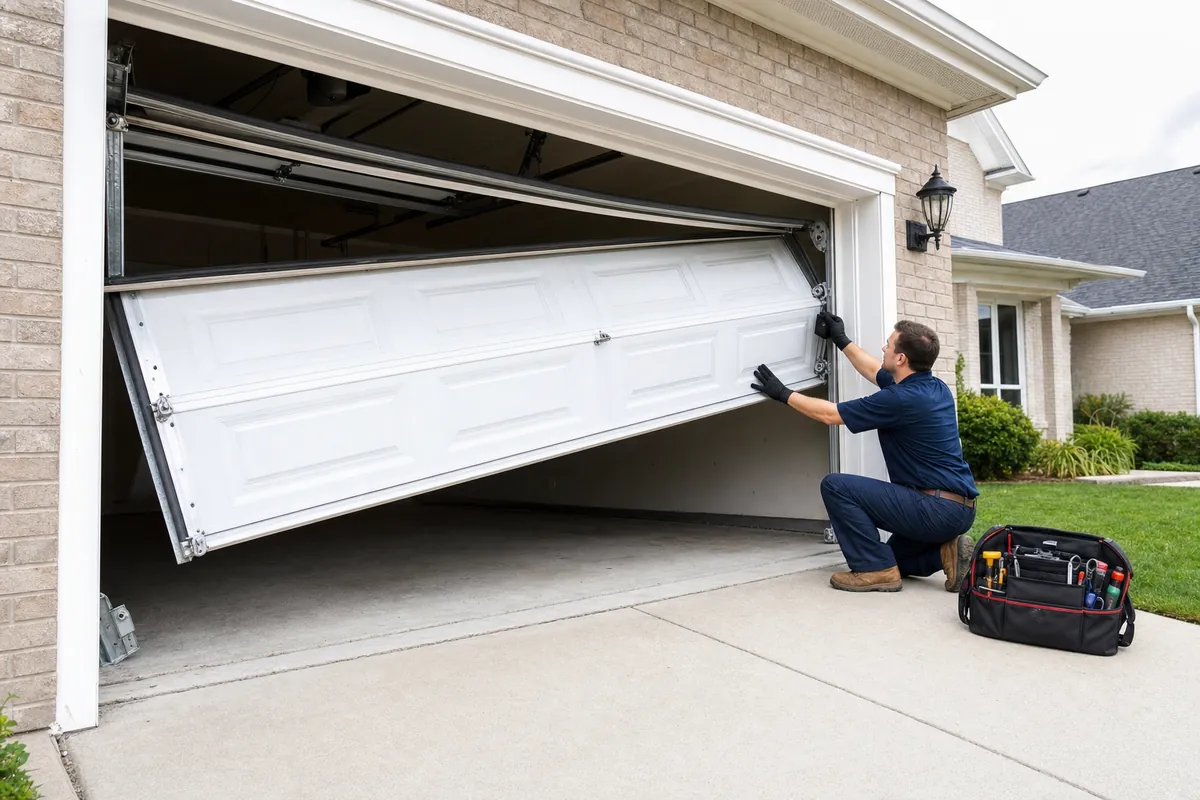
A sectional door pulled off its tracks, taken down and supported on site so it could be checked and re-hung safely — photographed on the job.
