
Garage Door Spring Replacement
Matched replacement springs sized to the door, not to a generic average.
View detailsStabilising doors that are stuck open, hanging crooked, or unsafe to touch.

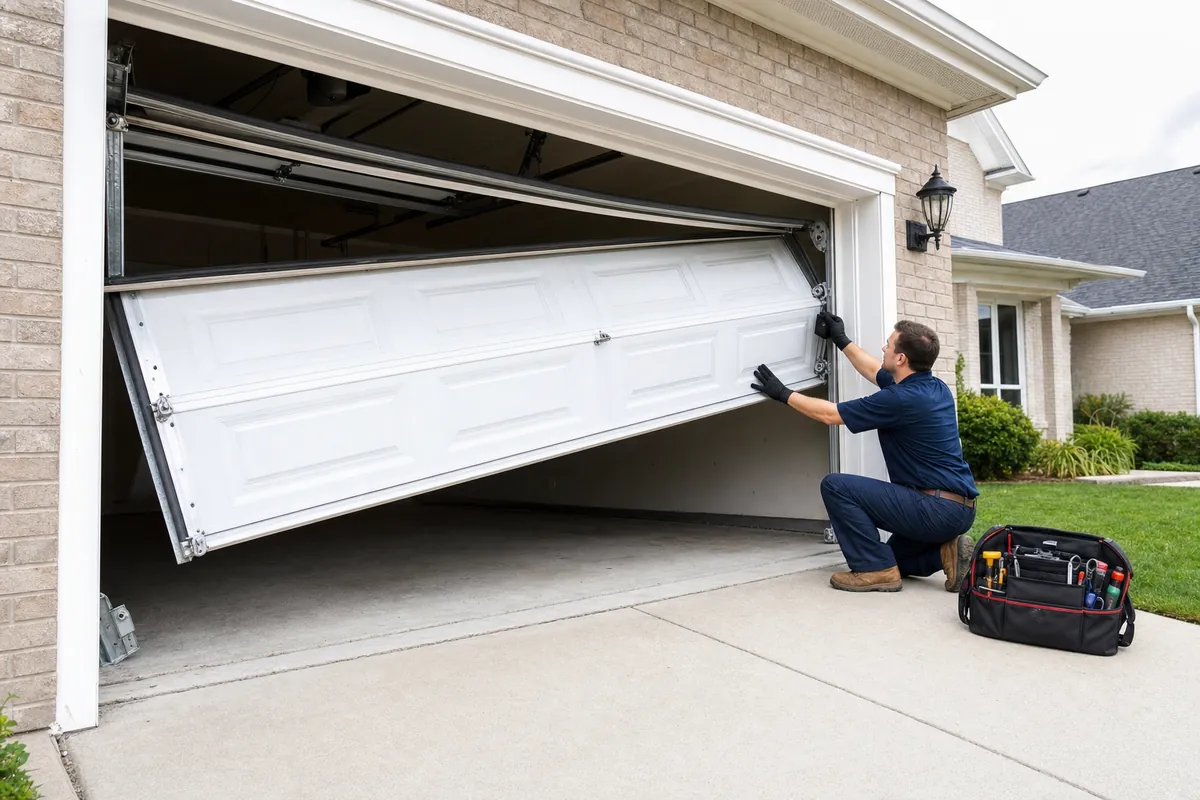
A garage door turns into a safety problem the moment it stops behaving predictably: hanging above the floor and refusing to come down, sitting crooked in the opening, leaning inward off its track, or bound to an icy slab while the opener strains against it. The part you can see is often not the part that failed. A broken torsion spring leaves the operator trying to lift a door it was never sized to carry; a cable that has jumped its drum lifts one side and abandons the other. The order of work is always the same: make the door safe where it stands, find the actual failure, then restore controlled movement before anything is powered up again. Send the booking form with the door's position and anything visibly broken, and photographs if you can take them safely.
An urgent fault does not mean the door has reached the end of its life. A snapped cable, a failed roller, a damaged seal or a knocked sensor can each be a contained repair on an otherwise sound door. What justifies a wider condition check is a distorted section, a cracked bottom bracket, a bent horizontal rail or a spring system that has been running out of specification for a while, because those affect how the whole door is supported. Repair makes sense when the remaining hardware is sound and the door can be balanced again; replacement makes sense when the failure is a symptom of the door as a whole being finished.
Work through the symptom first — some of these turn out to need no technician at all.
A torsion or extension spring normally offsets almost all of the door's weight. When one breaks, the opener is asked to lift a load it was never rated for, so it stalls, hums, or moves the door a few centimetres and gives up.
A roller that binds or leaves the guide lets a cable go slack and unwrap from its drum. One side then lifts while the other stays put, racking the sections across the opening and bending hinges, brackets and track if the door keeps being run.
A bent track, a snapped roller stem, a shifted horizontal rail or something fallen into the opening will stop travel. The opener senses the resistance and reverses, but each repeated attempt adds load to the drive, the door arm and the top fixtures.
Meltwater refreezes around the bottom seal, which is designed to close a gap rather than to act as an anchor. Lifting against that bond tears the seal, pulls the bottom section, or overloads the operator arm long before the ice gives way.
Winter is when most Pickering emergency calls happen. The nearest reporting climate station to the city averages -5.0 C in January with a mean daily minimum of -8.9 C and 33.5 cm of snow in that month alone, and Durham Region's own climate analysis uses a regional baseline of roughly 80 freeze-thaw cycles a year. That figure is the real story: the damage is done by water that melts and refreezes rather than by cold on its own. On a ravine-edge lot above the Rouge, Petticoat or Duffins valleys, where grading often runs toward the house and the garage side stays damp, meltwater collects at the apron and locks the seal overnight. Clear the snow and soften the ice instead of asking the opener to break it loose.
Keep people, pets and vehicles out from under a door that is raised, crooked or supported on one side. Do not pull the emergency release on a door that is hanging, do not unbolt a bottom bracket, do not attempt to unwind a torsion spring, and do not keep pressing the button to see whether it will go this time. A loaded cable or a fatigued spring stores enough energy to injure, and a door that is already out of square can fall. Clear the area, leave the opener alone, and use the form to arrange an assessment.
Nothing is released or reset until the door is assessed as it stands. A raised or crooked door is supported and prevented from moving while the affected hardware is identified, because a loaded cable or failed spring can let it drop without warning.
Springs, cables, drums, bottom brackets, rollers and track are read together. This separates the fault that started the event from the damage that happened after the door lost level, which is what stops the wrong part being replaced.
The failed component is repaired or replaced and the guide path is brought back into alignment. A cable is never simply wound back onto a system with a bent track or a seized roller, because it will come off again the next time the door runs.
The door is cycled by hand first to confirm balance and full travel, and only then is the opener reconnected and its safety reversal tested. A door that will not behave under hand power is not handed back to a motor.
Matched replacement springs sized to the door, not to a generic average.
View details
Frayed, slipped or snapped lift cables renewed and re-tensioned evenly.
View details
Worn rollers and bent guides corrected so the door runs quiet and square.
View detailsFill out the form and we'll confirm your appointment by email.
Emergency Garage Door Repair is available across every Pickering neighbourhood inside the area below.
Map data © Google. Pin shows the service area, not a walk-in location — all work is done at your home.