
Garage Door Spring Repair
Counterbalance adjustment and hardware correction on springs that are still intact.
View detailsMatched replacement springs sized to the door, not to a generic average.

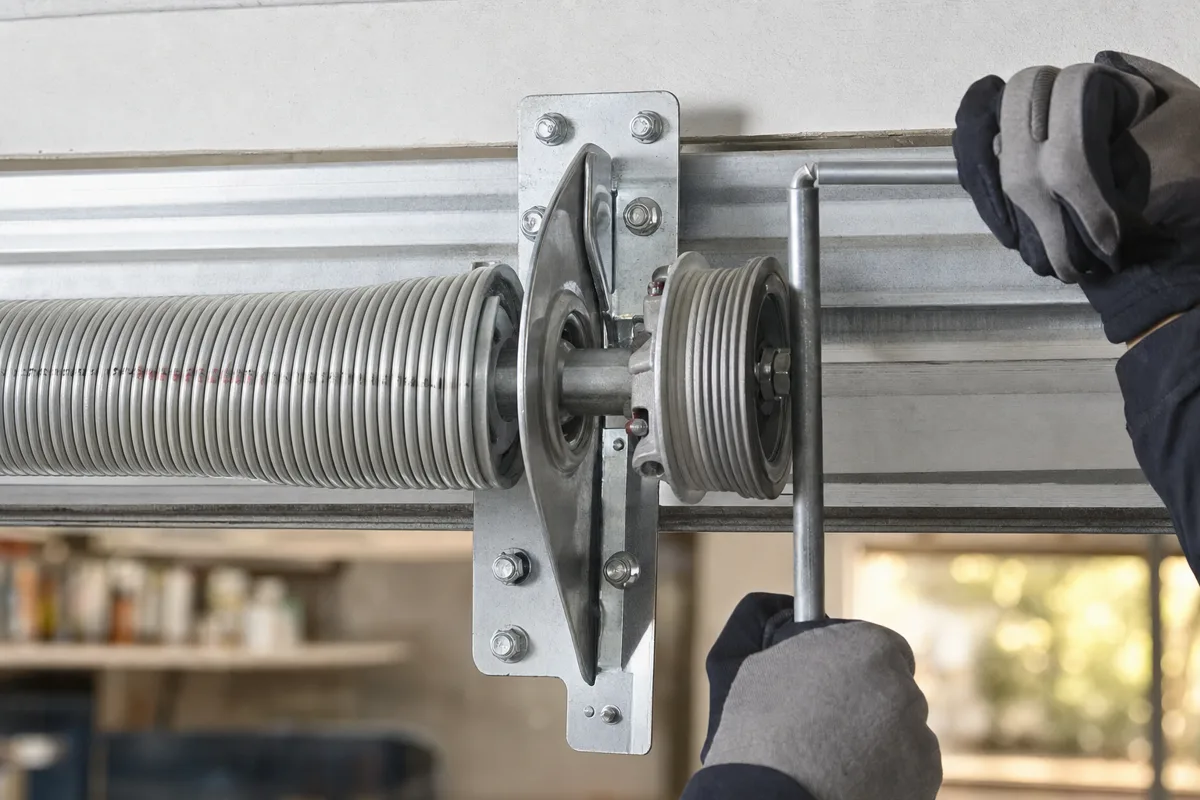
A broken torsion spring is the single most common reason a garage door stops working, and it announces itself clearly: a loud bang from the garage, often overnight, then a door that will not lift and an opener that hums or moves it a few centimetres. Look at the shaft above the opening and you will usually see a gap in one of the coils. Replacement is not a matter of fitting whatever is on the van. The correct spring is determined by wire size, inside diameter, length, wind direction and the door's travel height, all matched to the weight of the door actually hanging in the opening — which is why the measurement matters more than the part.
When one spring on a two-spring door breaks, replacing the pair is normally the right call. Both were installed together, both have taken the same cycles, and the survivor is usually close to the same fatigue point, so replacing one leaves the door unevenly counterbalanced and books a second visit. Where a door is cycled heavily — a busy four-bedroom family house, or a townhouse garage that doubles as the only parking — a higher-cycle spring specification is worth discussing at replacement time, because the cost difference is in the wire rather than in the labour.
Work through the symptom first — some of these turn out to need no technician at all.
Every spring has a rated number of open-and-close cycles, and metal fatigue is cumulative. Doors in single-phase neighbourhoods such as Brock Ridge, where 64 per cent of homes went up in one 1980s decade, tend to reach that limit within a few seasons of each other.
A spring set sized to the lightest door in a builder's range, or carried over when a heavier door was installed, runs at a higher stress per cycle than it should. It works, then fails earlier than the owner has any reason to expect.
Rust concentrates stress at a single point on the wire. On damp ravine-edge and creek-side lots, and in unheated detached garages in the northern hamlets, that is why a spring fails at one coil rather than uniformly along its length.
A door that has been out of specification for months has been loading the cables, drums and opener as well as the springs. The spring is what breaks first, but the rest of the system has been absorbing the difference in the meantime.
Spring failures cluster in Pickering's single-phase neighbourhoods. Brock Ridge is 64 per cent 1980s housing, West Shore is 70 per cent 1961-to-1980, Amberlea is 39 per cent 1980s and 34 per cent 1990s, and Highbush is 53 per cent 1990s, so when doors were hung in one wave the springs reach their cycle limits in one wave too. Winter is when the failure surfaces: with a January mean of -5.0 C at the nearest reporting station and a Durham regional baseline of roughly 80 freeze-thaw cycles a year, a door that is already marginal has to fight thickened grease and a seal stuck to a cold slab, and that is often the cycle that finishes a tired spring.
A torsion spring stores enough energy to break bones, and it does not become safe because it has already snapped — the second spring on a two-spring door is usually still fully wound. Winding bars are the only correct tool, the door must be secured before anything is unbolted, and bottom brackets must never be loosened while cables are under tension. Extension springs without an intact safety cable can travel across a garage when they let go. This is the repair least worth attempting from a video, and the one where the consequences of getting it wrong are immediate.
The existing springs are measured for wire size, inside diameter, length and wind, and the door's weight and travel height are established. Where the original set was under-specified, the replacement is sized to the door rather than copied from what failed.
Remaining tension is unwound with winding bars before anything is unbolted, and the door is secured so it cannot move. On extension spring systems the safety cable arrangement is checked and restored as part of the work.
New springs are installed with the correct wind direction, the drums are re-set so both cables take up evenly, and the set is wound to balance the actual door. Bearings, the centre bracket and the cables are inspected while everything is accessible.
The door is cycled by hand and must hold position at several heights before the opener goes back on. Force and travel settings are then checked and the safety reversal is tested on a door that is doing its own lifting.
Counterbalance adjustment and hardware correction on springs that are still intact.
View details
Stabilising doors that are stuck open, hanging crooked, or unsafe to touch.
View details
Frayed, slipped or snapped lift cables renewed and re-tensioned evenly.
View detailsFill out the form and we'll confirm your appointment by email.
Garage Door Spring Replacement is available across every Pickering neighbourhood inside the area below.
Map data © Google. Pin shows the service area, not a walk-in location — all work is done at your home.
A real callout, not stock imagery.
A sectional door pulled off its tracks, taken down and supported on site so it could be checked and re-hung safely — photographed on the job.