
Garage Door Maintenance & Tune-Up
Seasonal checks that catch wear before a Durham winter finds it first.
View serviceDoors get louder slowly, which is why most people stop noticing. The useful skill is separating the noises that describe wear from the one noise that describes a failure — because they need very different responses.
One loud bang followed by a door that will not lift is almost always a broken torsion spring — stop using the door and book service. Repetitive squealing or grinding usually means dry or worn rollers, hinges and bearings. Rattling points at loose hardware or a stretched chain, and scraping at debris or misalignment in the track. Never grease the track itself, and never work on springs or cables.
Every sound a garage door makes has a mechanical source, and the character of the sound narrows it down quickly. A single loud bang is a category of its own and usually means stored energy has released. Rhythmic squealing and grinding come from bearings, rollers and hinges that have run dry or worn. Rattling and slapping generally come from loose fixings, a stretched chain or a door that has worked out of square. Scraping is the guide path. What makes noise worth attending to is that a door which has become loud is a door whose components are loading each other differently than they should, and that shortens the life of everything on it, the opener included.
Start at the top. The early checks are the most common causes and need no tools.
Note whether it happens once or repeatedly, whether it tracks the door's movement or the motor's, and whether it occurs at one particular height. A noise that repeats at the same point in travel is a component passing a specific place; a noise that rises with speed is usually the drive or a bearing. Write down what you hear before you start opening and closing the door repeatedly.
What it means: A single bang is treated completely differently from a repeating noise.
With the door closed, stand back and look at the torsion spring on the shaft above the opening. A clear 5 to 10 cm gap in what should be a continuous coil means the spring is broken. Do not touch it, do not attempt to use the door, and do not try the opener again. If there are two springs, one can be broken while the other still holds partial tension.
What it means: A visible gap in the coil means stop using the door immediately.
If nothing looks broken, disconnect the operator with the door closed and lift the door by hand. It should move smoothly and hold roughly where you leave it. Grinding or catching that you can feel through your hands as you lift tells you the resistance is mechanical and is where the noise is coming from, rather than in the motor.
What it means: Resistance or catching by hand localises the noise to the door, not the opener.
Look for rollers whose stems have visible play, bearings that look dry or rusty, hinges with elongated holes or cracks at the flange, and track brackets or lag bolts that have worked loose. On Pickering's valley-edge lots the bottom rollers and brackets are the first to suffer, because that is where damp sits through the winter.
What it means: Play, rust or loose fixings explain most squealing, grinding and rattling.
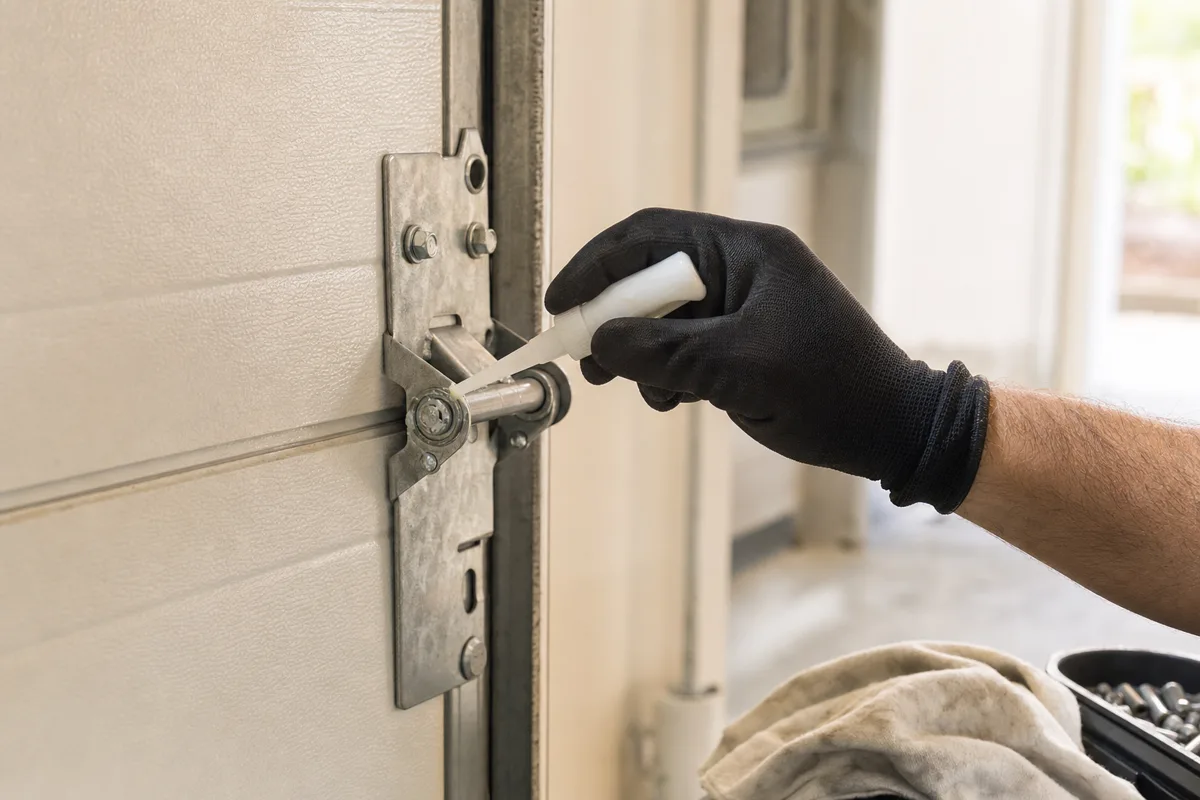
Clear grit and leaf litter out of the bottom of both vertical tracks and wipe the track faces dry. Apply a proper garage-door lubricant to roller bearings, hinge pivots and the end bearings, then wipe the excess. Leave the track itself dry — grease there collects grit and becomes an abrasive paste. Do not lubricate or otherwise touch springs and cables if anything looks damaged.
What it means: If cleaning and lubrication restore quiet operation, the noise was dry wear rather than failure.
A single loud bang, a spring with a visible gap in its coil, a slack or frayed cable, or a door that suddenly needs both arms to lift all mean stop. Torsion springs hold enough stored energy to cause serious injury, and cables under load will move violently if a bracket or termination is disturbed. Do not attempt to wind, unwind or replace a spring, do not unbolt a bottom bracket, and do not keep running the opener to see whether the noise repeats. If the door will not hold position when released, it is not safe to use.
Noise complaints in Pickering cluster in two places. The first is the mature lakeshore and central stock — Bay Ridges, West Shore, Woodlands, Dunbarton — where original 1960s and 1970s hardware has done a great many cycles and where damp on ravine-edge and creek-side lots has been working on the low components for decades. The second is the townhouse stock in Duffin Heights, Village East and Seaton, where the door sits directly under a bedroom, so a builder-standard chain drive on a door running slightly out of square becomes the loudest thing in the house at 6 a.m. even though nothing has failed.
Fill out the form and we'll confirm your appointment by email.
These guides are written for Pickering homes. If the fix is beyond a homeowner check, we work everywhere inside this area.
Map data © Google. Pin shows the service area, not a walk-in location — all work is done at your home.

A real callout, not stock imagery.
A sectional door pulled off its tracks, taken down and supported on site so it could be checked and re-hung safely — photographed on the job.
