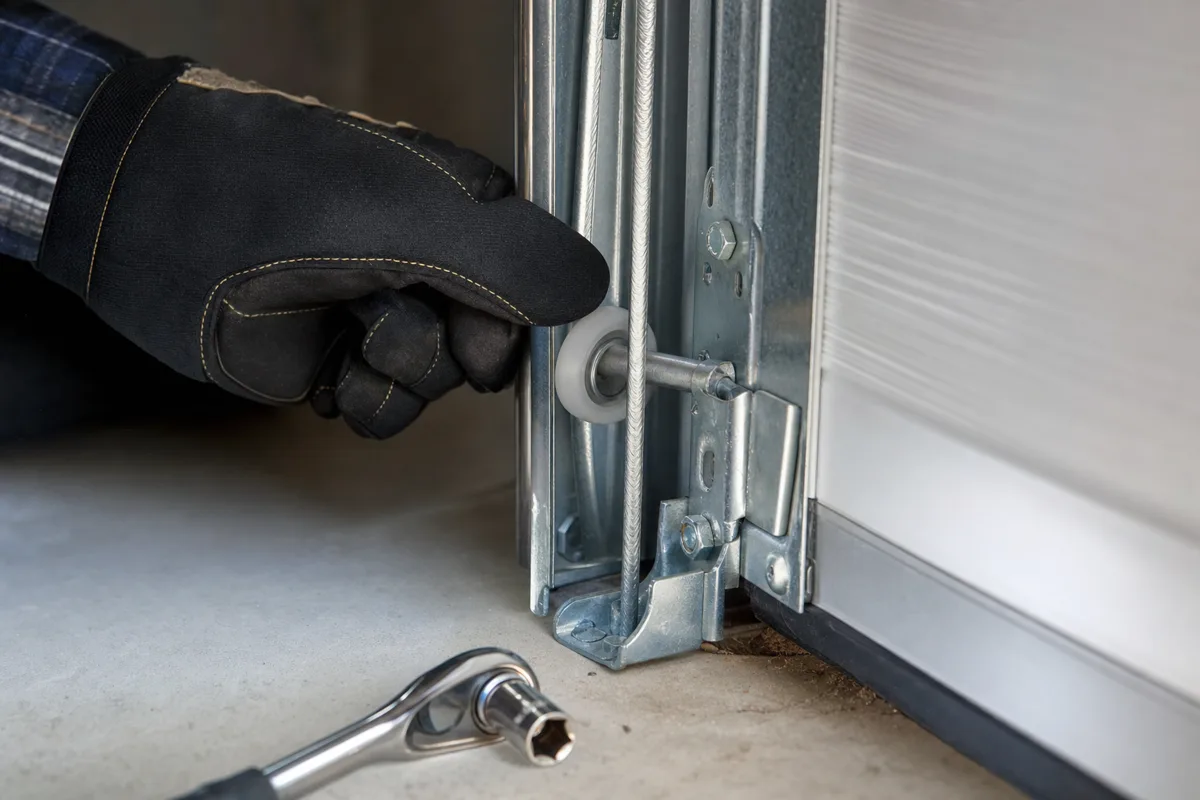

Garage Door Roller & Track Repair
Worn rollers and bent guides corrected so the door runs quiet and square.
View serviceA door off its track is the one fault where doing nothing is the correct first action. The rollers are what hold the door in the opening, and once they are out, the door's weight is being carried by things not designed to carry it.
Stop operating the door and keep people and vehicles out from under it. An off-track door is unsupported in part of its opening and can fall or shift without warning. Do not try to lever a roller back into the track, and do not pull the emergency release while the door is raised. Note whether a cable is slack, a spring shows a gap, or the track is visibly bent, then book service — this is not a DIY repair.
A sectional door is held in the opening by rollers running in a track, with the weight balanced by the spring set and transferred through cables to the drums. When a roller leaves the track — after an impact, a broken cable, a loose bracket or an obstruction under one side — the door racks across the opening and the load redistributes into hinges, sections and brackets that were never meant to take it. Operating the opener at that point is what turns a roller and bracket repair into twisted sections and a bent track. This guide is about recognising the fault, understanding what is unsafe about it, and knowing what to secure before help arrives.
Start at the top. The early checks are the most common causes and need no tools.
Switch off or unplug the operator so nobody presses the button, move vehicles out of the doorway if that can be done safely without passing under the door, and keep children and pets away. An off-track door can move suddenly as load redistributes, and the opening is the one place you do not want to be standing.
What it means: Once the area is clear and the opener is off, nothing else needs to be rushed.
From a safe distance and to one side, look for a roller sitting outside its track, a section pushed out of line with the others, a visible bend or spread in the vertical track, or the door sitting noticeably crooked in the opening. Photograph it if you can — that helps considerably when describing the situation.
What it means: A roller out of track or a door hanging crooked confirms an off-track event.
Look at whether both lift cables are taut and seated in their drums, or whether one has gone slack, frayed or unwound. Then check the torsion spring above the opening for a gap in the coil. A broken cable or spring is frequently the cause of the door leaving the track rather than a consequence of it.
What it means: A slack cable or a gapped spring means stored energy is involved and the door is definitely not to be touched.
Think back to whether the door was struck by a vehicle, whether something was left in its path, whether it had been getting noisier, or whether a bracket had been working loose. On tight townhouse frontages in Village East, Duffin Heights and the Seaton street townhouses, vehicle contact is a routine cause; so is debris in the bottom track.
What it means: Knowing the cause determines whether the repair is hardware only or includes sections and track.
Decide how you will get in and out until the visit — a side door, another entrance — and do not attempt to hand-lift or hand-lower the door to free a vehicle. If the door is stuck partly open, keep the space beneath it clear and do not store anything there. Wait for the door to be supported and the tension controlled properly.
What it means: Leaving the door untouched keeps the repair to the smallest scope possible.
An off-track door is partially unsupported and can fall, twist or shift without warning. Do not lever, hammer or pry a roller back into its track, do not unbolt a bottom bracket or touch a cable — both are attached to the counterbalance and hold stored energy — and do not pull the emergency release while the door is raised, because that can drop the door. Do not park or stand beneath a door that is stuck partly open, and do not run the opener again to test whether it will correct itself. It will not.
Driveway and lane geometry drives a lot of this in Pickering. Village East is about 33 per cent row housing and 21 per cent high-rise, Duffin Heights is around 37 per cent row housing, and Seaton street townhouses start from 6 metres of frontage per unit with many garages reached from a rear lane, so vehicles manoeuvre very close to doors as a matter of routine. In the older lakeshore neighbourhoods the more common trigger is wear: decades-old brackets working loose, and leaf litter and road grit from ravine-edge lots collecting in the bottom of the vertical track until a roller is forced to climb out of it.
Fill out the form and we'll confirm your appointment by email.
These guides are written for Pickering homes. If the fix is beyond a homeowner check, we work everywhere inside this area.
Map data © Google. Pin shows the service area, not a walk-in location — all work is done at your home.

A real callout, not stock imagery.
A sectional door pulled off its tracks, taken down and supported on site so it could be checked and re-hung safely — photographed on the job.