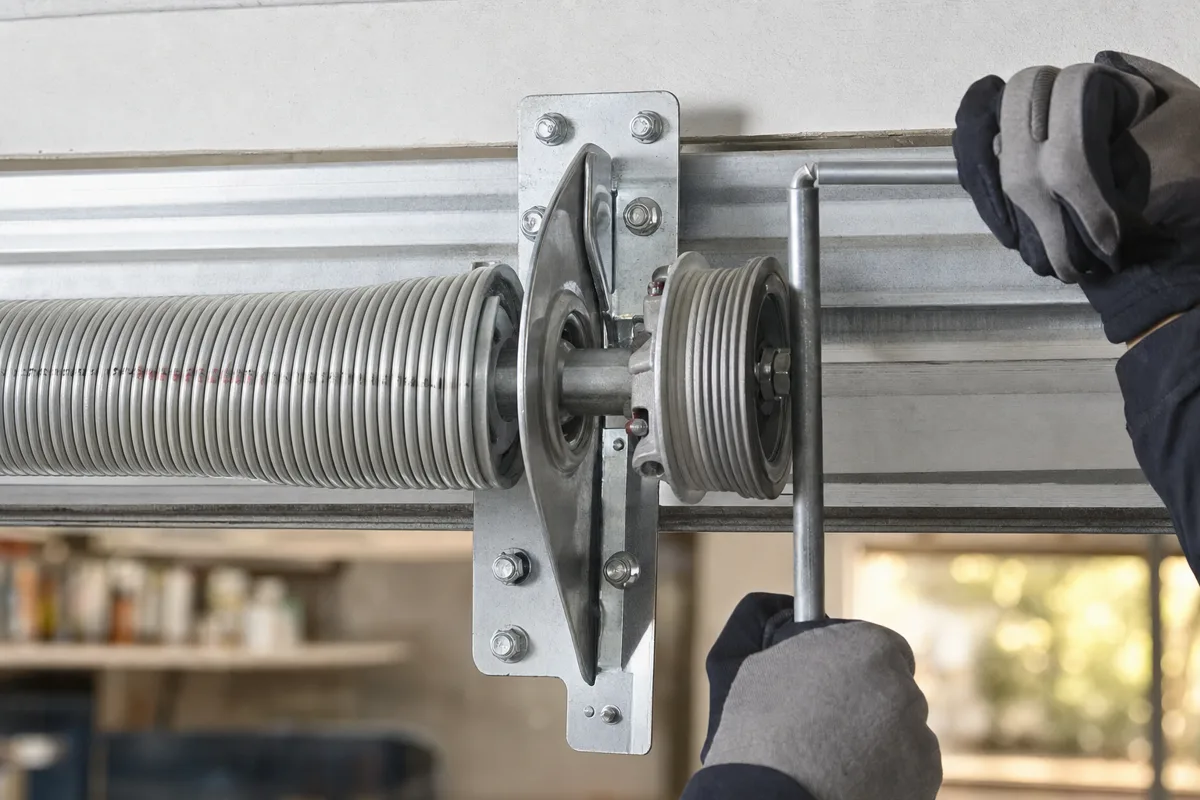

Garage Door Spring Replacement
Matched replacement springs sized to the door, not to a generic average.
View serviceThe springs, not the opener, carry the weight of a garage door. When a spring breaks, a door that felt light becomes 60 to 90 kilograms of dead weight in an instant — and the opener is the part that gets blamed.
Look at the torsion spring on the shaft above the closed door. A gap of roughly 5 to 10 cm in what should be an unbroken coil confirms a break. Other reliable signs are a bang followed by a door that will not lift, a door that feels enormously heavy by hand, and a door that drops rather than holds when released. Stop using the door and the opener, keep everyone clear, and book service — spring work needs winding bars and training.
A torsion spring stores energy as it winds, and that stored energy is what makes a heavy door feel manageable. Springs are rated in cycles rather than years, so a door that runs six times a day consumes its spring life several times faster than one that runs twice. The signs of failure are consistent and easy to recognise once you know them: a loud bang, a door that will not lift or lifts only a few centimetres before stopping, an opener that strains and gives up, and a visible gap in a coil that should be continuous. Confirming it is safe from a distance. Fixing it is not, and this guide is deliberately clear about where the line sits.
Start at the top. The early checks are the most common causes and need no tools.
Once you suspect a spring, stop pressing the button. An opener repeatedly trying to lift an unbalanced door strains the drive, the door arm and the top section where the arm attaches, and it can turn a spring replacement into a spring plus panel and drive repair. Leave the door where it is, closed if possible, and keep vehicles and people out from under it.
What it means: Ceasing operation prevents secondary damage while you confirm the diagnosis.
With the door closed, stand back and look at the spring or springs on the shaft above the opening. An intact torsion spring is a continuous coil. A break shows as a clear separation of 5 to 10 cm, sometimes with the two halves slightly rotated relative to each other. Look from a distance and do not reach up to touch or turn anything.
What it means: A visible gap confirms a broken spring without any further testing.
Only if nothing looks broken and the door still moves reasonably: with the opener disconnected and the door closed, lift the door to about waist height and let go. A door in balance stays roughly where you left it. A door that drops or slams shut, or that shoots upward, has a counterbalance that no longer matches its weight even if the spring has not yet parted.
What it means: A door that will not hold position needs counterbalance work whether or not a coil has broken.
From a safe distance, check whether the lift cables on both sides are taut and still seated in their drums, and look for fraying or kinking near the bottom brackets. A spring failure often leaves cables slack or unwound, and a broken cable can leave the door hanging at an angle. Do not touch a cable or a bottom bracket at any point.
What it means: Slack, unwound or frayed cables mean the door is unsafe to operate at all.
For the service call, note whether there are one or two springs, whether the door is a single or a double, and roughly how many times a day it runs. A door serving a busy family house in Amberlea or Liverpool, where roughly half of homes have four or more bedrooms, may justify a higher cycle-rated spring set on replacement.
What it means: This information determines whether like-for-like or higher-cycle springs are the better choice.
Torsion springs hold enough stored energy to cause serious or fatal injury, and they release it faster than anyone can react. Do not attempt to wind or unwind a spring, do not use screwdrivers or improvised bars in the winding cone, and do not unbolt a bottom bracket or touch a cable under tension. Do not park under a door with a suspected spring failure, and do not keep cycling the opener to see whether it will manage. If a door is stuck open, keep the area beneath it clear until a technician has secured it.
Cold is what turns a worn spring into a broken one, and Pickering gets a proper winter: the nearest reporting climate station averages a January mean of -5.0 C, a mean daily minimum of -8.9 C and 33.5 cm of January snow, with a record January low of -32.8 C. Steel loses a little flexibility as it cools and grease in the rollers and hinges thickens, so the spring set works hardest on exactly the mornings you most need the door. Durham Region's baseline of roughly 80 freeze-thaw cycles a year adds a second factor at the bottom of the door, where damp on valley-edge lots corrodes cable terminations and bottom brackets.
Fill out the form and we'll confirm your appointment by email.
These guides are written for Pickering homes. If the fix is beyond a homeowner check, we work everywhere inside this area.
Map data © Google. Pin shows the service area, not a walk-in location — all work is done at your home.

A real callout, not stock imagery.
A sectional door pulled off its tracks, taken down and supported on site so it could be checked and re-hung safely — photographed on the job.