
Garage Door Spring Replacement
Matched replacement springs sized to the door, not to a generic average.
View detailsFrayed, slipped or snapped lift cables renewed and re-tensioned evenly.

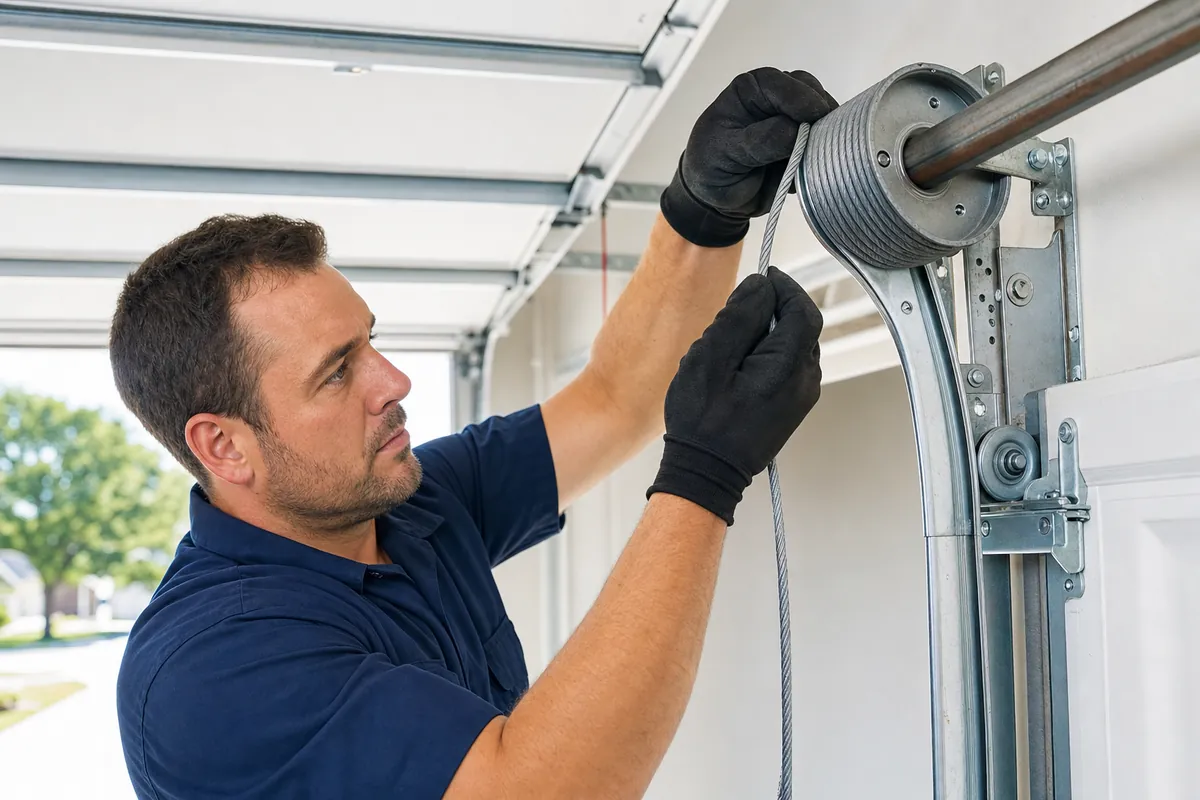
The lift cables are the quiet part of a garage door system. Each one runs from a bottom bracket up the side of the door and wraps around a drum on the spring shaft, translating the counterbalance into lift, and they only get noticed when one frays, slips off its drum or snaps. The result is unmistakable: one side of the door rises while the other stays down, the sections rack across the opening, and the door either jams or sits at an angle. Cable work is never just a matter of re-seating the cable — a cable comes off for a reason, and the reason is usually a roller, a track, a drum setting or a counterbalance that is out of specification.
Cables are inexpensive relative to what they protect, and they are renewed in pairs because a matched set keeps the two sides taking up evenly. Once fraying appears at a termination the cable is finished regardless of how many strands remain, since the load concentrates on the survivors. What determines whether the repair holds is the work around it: a cable fitted to a door with a seized roller, a bent track or a spring set out of specification will come off again, so the honest repair addresses whichever of those caused the failure in the first place.
Our troubleshooting guides walk the diagnostic checks in order so you can confirm the fault before booking.
Cables fray where water sits, which is at the bottom bracket and at the drum wrap. On damp valley-edge lots and in unheated rural garages that is exactly where the strands go first, often invisibly until a few break.
If the two drums are not set to take up equally, one cable slackens through the travel and can jump its groove. The door then lifts unevenly, which is both the symptom and the cause of further damage.
When a roller seizes or the track deforms, the door stops moving freely on one side. The cable goes slack, unwraps and comes off the drum. Re-seating it without correcting the guide path guarantees a repeat failure.
A broken spring, a door driven into while part-way open, or an opener forcing a door against an obstruction all put a shock load through the cables. They may survive the event and fail a few weeks later at the weakened point.
Cable failures follow moisture, which in Pickering means the valley edges and the rural north. The Rouge, Petticoat and Duffins creek systems cut deeply through the city, so a large share of homes sit on ravine or valley-edge lots where the garage side of the house stays damp, meltwater runs toward the apron and leaf litter holds water against the bottom hardware. Rosebank, Rouge Park, Highbush and Rougemount all have lots against park and valley land; Greenwood sits near Duffins Creek and the conservation area. With Durham Region using a baseline of roughly 80 freeze-thaw cycles a year, that trapped moisture spends the winter expanding and contracting against the strands.
Bottom brackets hold the cable ends and stay under full tension whenever the door is not resting on the floor, which is why they must never be unbolted on a raised or partly raised door. Do not attempt to wind a cable back onto a drum by hand, do not run the opener to see whether it will straighten itself out, and do not use a vehicle or a lever to force a racked door back into line. A door held by one cable can drop or twist without warning, and a slack cable can whip when tension returns to it.
The door is secured in position and spring tension is managed before any cable is touched, because a bottom bracket carries the full cable load and is the most dangerous fixing on the door to release under tension.
Rollers, track, drums, bearings and the counterbalance are checked to establish why the cable failed. Cables that come off repeatedly are almost always reporting a problem somewhere else in the system.
Both cables are normally renewed as a pair, routed correctly and seated in their drum grooves, and the drums are set so the two sides take up evenly through the whole travel rather than only at the closed position.
The door is brought back square in the opening and cycled by hand to confirm level travel and an even landing at the floor, then the opener is reconnected and its settings and safety reversal are verified.
Matched replacement springs sized to the door, not to a generic average.
View details
Worn rollers and bent guides corrected so the door runs quiet and square.
View details
Stabilising doors that are stuck open, hanging crooked, or unsafe to touch.
View detailsFill out the form and we'll confirm your appointment by email.
Garage Door Cable Repair is available across every Pickering neighbourhood inside the area below.
Map data © Google. Pin shows the service area, not a walk-in location — all work is done at your home.
A real callout, not stock imagery.
A sectional door pulled off its tracks, taken down and supported on site so it could be checked and re-hung safely — photographed on the job.