
Garage Door Spring Repair
Counterbalance adjustment and hardware correction on springs that are still intact.
View detailsSeasonal checks that catch wear before a Durham winter finds it first.

Maintenance on a garage door is not polishing; it is catching the parts that still work but are no longer in specification. A spring that has drifted, a cable starting to fray at the drum, a roller with play in its stem, a hinge that has worked loose, a bottom seal that has gone hard, an opener quietly compensating for all of it. Each of those is cheap to correct and expensive to ignore, because a door that is out of specification loads every other component every time it runs. The point of a scheduled visit is to find the sequence before it becomes an emergency in January.
Maintenance does not make a door immortal; it makes its life predictable. Rollers, seals, hinges and cables are consumables and get renewed when they are worn. Springs are cycle-limited and eventually get replaced whatever is done for them, but a set that is kept in balance on a door running on clean track gets closer to its rated life than one fighting a binding guide path. The real return is that failures happen on a scheduled visit in November instead of on a -9 C morning with a car trapped behind a door that will not lift.
Work through the symptom first — some of these turn out to need no technician at all.
Every component on a door is consumed by cycles rather than by time. On family houses in Amberlea and Liverpool, where roughly half of homes have four or more bedrooms, those cycles accumulate quickly and quietly.
Valley-edge and creek-side lots keep the low hardware damp, so bottom rollers stiffen, bottom brackets corrode at the cable terminations, and seals harden. With Durham Region's baseline of about 80 freeze-thaw cycles a year, that moisture is worked on all winter.
Leaf litter from the Rouge and Duffins valleys, road grit through the winter and sand in spring collect in the bottom of the vertical track, which forces the rollers to climb and makes the opener work against resistance.
Builder installations in Duffin Heights and Seaton are frequently left at factory travel and force defaults, and older openers are often set to a door that has changed since. Neither is a fault, but both make the system run harder than necessary.
Timing matters in Pickering. The nearest reporting climate station to the city averages 101.7 cm of snow a year with 33.5 cm of it in January, a January mean of -5.0 C, a mean daily minimum of -8.9 C and a record January low of -32.8 C, and Durham Region works from a baseline of roughly 80 freeze-thaw cycles a year — materially more cycling across the freezing point than areas further west see. That is the argument for a late-autumn visit rather than a spring one: the failures cluster in the cold, and the components that fail have usually been out of specification since the summer.
Household maintenance stops at what can be done without touching stored energy. Clearing the bottom track, wiping the photo-eye lenses, checking that the seal meets the floor and running the monthly balance and reversal tests are all safe and worth doing. Winding or unwinding a torsion spring, adjusting drums, unbolting a bottom bracket or working on a cable under tension are not; those need the right tools and someone who knows what the door will do when the load moves. If any test shows the door failing to hold position or failing to reverse, stop using it.
The operator is disconnected with the door closed and the door is moved by hand and left at several heights, which establishes whether the counterbalance still matches the door before anything else is judged.
Springs, cables at both terminations, drums, bearings, rollers, hinges, track alignment and fixings, the bottom seal, the top section and the operator arm bracket are all checked in sequence rather than sampled.
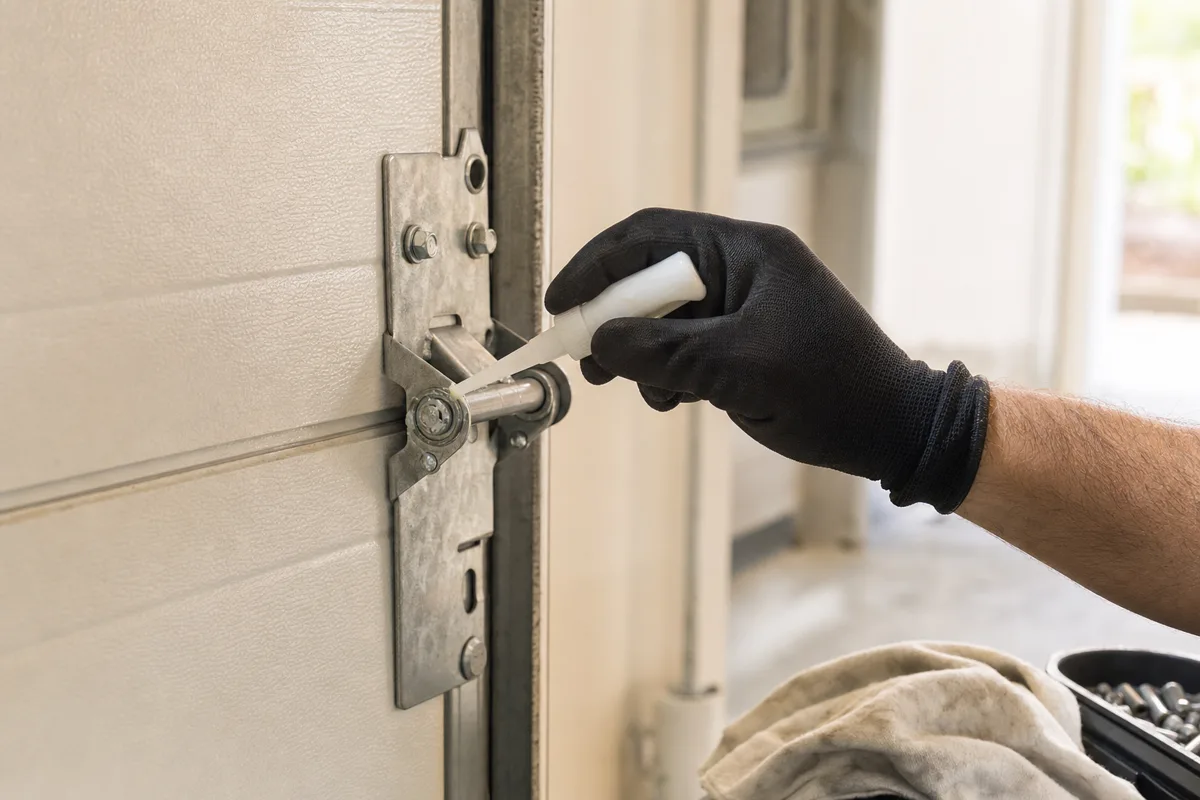
Tension and drum take-up are adjusted where needed, loose fixings are secured into sound backing, worn rollers and hinges are replaced, and hinges, rollers, bearings and the spring set are lubricated. The track is cleaned, not greased.
Travel and force limits are set to the door as it now runs, photo eyes are cleaned, aligned and re-secured, and both the beam interruption and contact reversal are tested before the visit closes.
Counterbalance adjustment and hardware correction on springs that are still intact.
View detailsWorn rollers and bent guides corrected so the door runs quiet and square.
View details
Motor, sensor, logic-board and drive faults diagnosed without masking door problems.
View detailsFill out the form and we'll confirm your appointment by email.
Garage Door Maintenance & Tune-Up is available across every Pickering neighbourhood inside the area below.
Map data © Google. Pin shows the service area, not a walk-in location — all work is done at your home.

A real callout, not stock imagery.
A sectional door pulled off its tracks, taken down and supported on site so it could be checked and re-hung safely — photographed on the job.