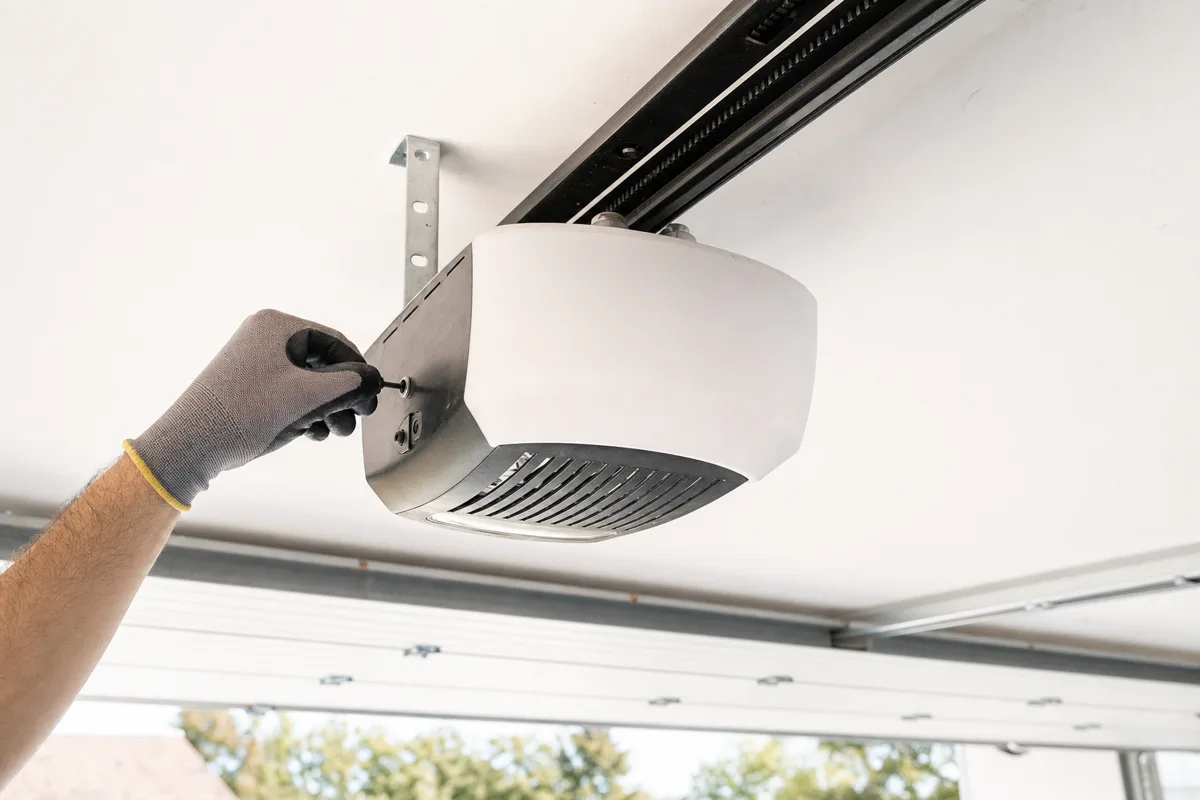

Garage Door Opener Installation
New operators fitted to balanced doors, with the safety reversal tested.
View detailsMotor, sensor, logic-board and drive faults diagnosed without masking door problems.

An opener is a motor, a drive, a control board, a set of safety devices and a pair of remotes, and each of those fails in its own way. The trap is that an opener also fails when nothing is wrong with it — when the door has become too heavy, too tight or too crooked for the motor to move, the opener is what looks broken. So a proper diagnosis separates the two: is the door capable of moving freely on its own, and if it is, which part of the drive or control chain has stopped doing its job? Skipping that step is how a working motor gets replaced while the actual mechanical fault stays in place.
Repair is usually the better answer when the mechanical door is sound and the fault is a sensor, a wall control, wiring, a remote or a single drive component. Replacement makes more sense when a logic board has failed on a unit whose parts are no longer available, when the drive has worn to the point of slipping, or when the existing operator predates the rolling-code and safety-reversal features now standard. On a door whose counterbalance is also finished, replacing both at once avoids paying twice for the same visit and lets the operator be matched to the new door weight.
Work through the symptom first — some of these turn out to need no technician at all.
A failed or drifting spring set, a binding roller or a door running out of square leaves the operator asking for more force than it is allowed to use. The opener stalls or reverses and appears faulty while the real fault is mechanical.
Photo eyes that are dirty, knocked out of alignment, wired loose or hit by low winter sun will stop a door closing. Most openers signal this with a flashing light or a repeating beep rather than an error anyone can read at a glance.
Chains stretch, belts age, trolleys and gear assemblies wear, and a drive that has been fighting a heavy door wears faster still. The symptom is usually noise or slipping before it becomes a complete stop.
Logic boards fail, particularly after a surge; remotes lose their programming or their batteries; wall controls and wiring corrode in a damp garage. Any of these can look like a dead motor from the driveway.
Opener faults have a seasonal shape in Pickering. Low winter sun off the lake and off fresh snow strikes photo eyes at exactly the wrong angle, and with 101.7 cm of snow in an average year at the nearest reporting station there is plenty of it about. Cold thickens grease in rollers and hinges so the door needs more force in January than in July, which is when a marginal opener finally refuses. In Seaton and Duffin Heights the pattern is different again: those doors are new, so the recurring findings are factory-default travel and force settings, and photo eyes knocked out of alignment during landscaping or by construction traffic.
Never disable a photo eye, bridge its wiring or tape a sensor to point at itself to get a door to close; that removes the protection that stops the door closing on a child or a pet. Do not use the hold-to-run wall button as a permanent solution, because openers fall back to that mode precisely when they cannot confirm the safety beam. Unplug the operator before working near the drive or the trolley, and never pull the emergency release while the door is raised. If the door needs force to move by hand, the opener is not the problem to solve first.
The operator is disconnected with the door closed, then the door is moved by hand and left at several heights. If it will not run freely and hold position, the mechanical fault is addressed before the opener is judged at all.
Indicator lights, flash patterns and the behaviour of the wall control versus the remotes narrow the fault to the safety circuit, the logic board, the drive or the power supply before anything is dismantled.
Sensors are cleaned, realigned and re-secured; wiring and connections are corrected; drive components are replaced where they are worn; travel and force limits are set to the door as it now runs rather than to the door as it was.
The photo-eye interruption and the contact reversal are both tested at the end, because an opener that runs the door but no longer reverses correctly is a hazard rather than a repair.
New operators fitted to balanced doors, with the safety reversal tested.
View details
Counterbalance adjustment and hardware correction on springs that are still intact.
View details
Seasonal checks that catch wear before a Durham winter finds it first.
View detailsFill out the form and we'll confirm your appointment by email.
Garage Door Opener Repair is available across every Pickering neighbourhood inside the area below.
Map data © Google. Pin shows the service area, not a walk-in location — all work is done at your home.

A real callout, not stock imagery.
A sectional door pulled off its tracks, taken down and supported on site so it could be checked and re-hung safely — photographed on the job.