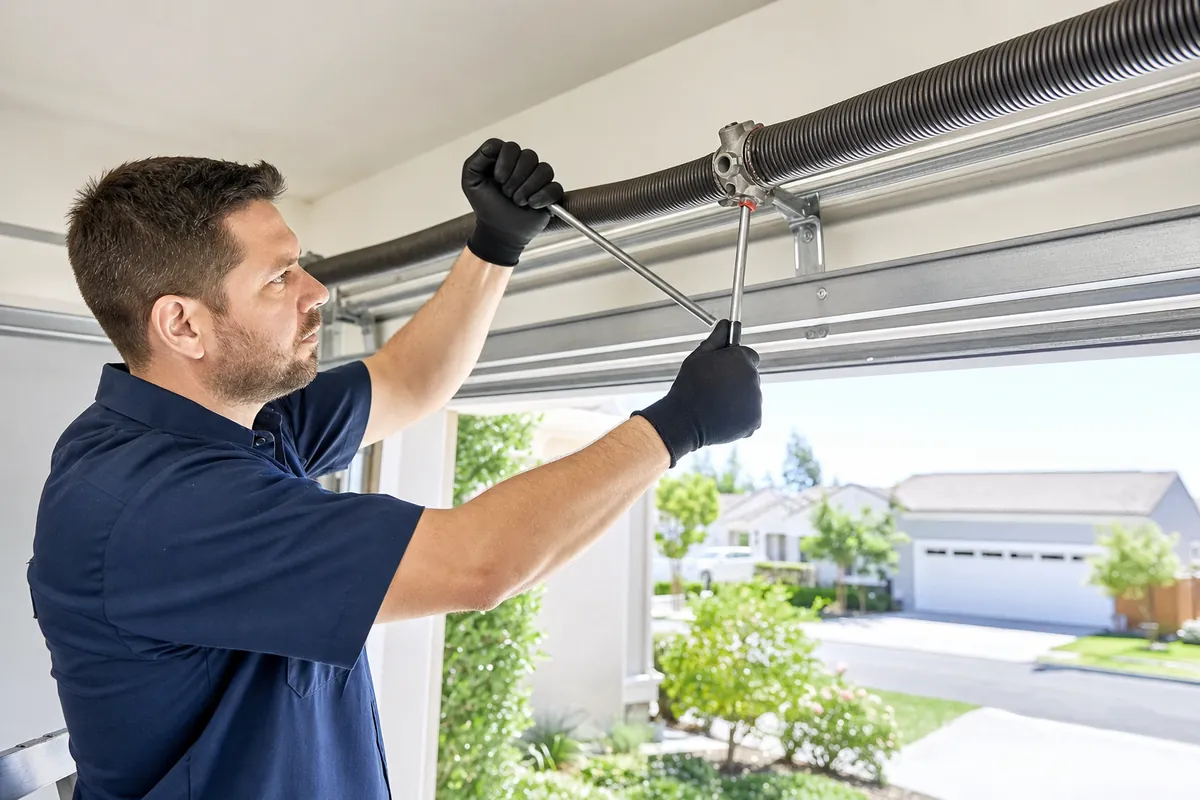

Garage Door Spring Replacement
Matched replacement springs sized to the door, not to a generic average.
View detailsCounterbalance adjustment and hardware correction on springs that are still intact.

Not every counterbalance problem is a broken spring. A spring set can be intact and still be wrong: wound to the incorrect tension, drifting out of balance as the wire relaxes, working against a bent bracket, or paired with drums that are no longer set evenly. The symptom is a door that lifts unevenly, feels heavy at one point in its travel, drifts down when it should hold, or fights the opener without ever failing outright. Repair work here is measurement and adjustment rather than replacement: reading the door's actual weight and travel, checking the shaft, bearings, anchor bracket and drums, and correcting what is out of specification while the springs themselves still have usable life.
Springs are rated in cycles, not in years, and a cycle is one full open and close. A four-bedroom family house in Amberlea or Liverpool can consume that rating far faster than a two-person household on the same street, which is why age alone is a poor guide. Adjustment is the right answer while the wire is still within specification and the door can be brought back into balance. Once a set has relaxed past the point where correct winding restores balance, or shows pitting, gapping or a visible set, replacement is the honest recommendation rather than another turn of tension.
Work through the symptom first — some of these turn out to need no technician at all.
Spring wire relaxes as it accumulates cycles, so a set that was correct on installation slowly stops matching the door's weight. The door becomes bottom-heavy, the opener takes up the difference, and the whole system runs harder than it was designed to.
On a two-cable door the drums must be set so both cables take up equally. When one is out, one side lifts marginally ahead of the other, which racks the sections, wears the vertical track and eventually lets a cable go slack.
End bearing plates and the centre bearing carry the shaft, and the anchor bracket holds the stationary end of the spring against the header. A dry bearing or a bracket working loose in old framing introduces friction and noise that get blamed on the springs themselves.
A heavier replacement section, an insulation kit added after the fact, or accumulated ice and water in the bottom section changes what the spring set is asked to hold. The counterbalance no longer matches the door, even though nothing has broken.
Pickering's mature lakeshore neighbourhoods are where tension drift shows up most. Seventy per cent of West Shore and 56 per cent of Bay Ridges was built between 1961 and 1980, and doors on those original openings have accumulated decades of cycles, so a spring set that is still intact is often no longer holding the door it was fitted to. Cold makes it obvious: with January averaging -5.0 C at the nearest reporting station and a mean daily minimum of -8.9 C, grease thickens and a door that is marginally out of balance in summer becomes a door that will not hold in January. Adjustment before the season turns is cheaper than a call-out during it.
A wound torsion spring holds a large amount of energy whether or not the door is moving. Winding bars are the only correct tool and screwdrivers are not a substitute; slipping under load is how people are badly hurt. Extension springs on older single-bay garages carry the same risk with less containment, particularly where the safety cable through the middle is missing. Do not adjust winding cones, do not loosen the anchor bracket, and do not unbolt a bottom bracket while a cable is under tension. Adjustment is worth booking rather than attempting.
The operator is disconnected and the door is moved by hand and left at several heights. Where it holds and where it wants to travel tells you far more about the counterbalance than any inspection of the springs at rest.
Wire size, inside diameter, spring length and the travel height are recorded, along with the door's weight where it can be established. Those numbers are what determine whether the existing set can be adjusted into specification or has to be replaced.
Winding is adjusted with proper bars, never with improvised tools, and the drums are set so both cables take up evenly. Bearings, the centre bracket and the anchor fixing are checked and corrected as part of the same visit.
The door is cycled by hand to verify it holds position and lands level, then the opener is reconnected and its force and travel settings are checked against a door that is now doing its own work.
Matched replacement springs sized to the door, not to a generic average.
View details
Frayed, slipped or snapped lift cables renewed and re-tensioned evenly.
View details
Seasonal checks that catch wear before a Durham winter finds it first.
View detailsFill out the form and we'll confirm your appointment by email.
Garage Door Spring Repair is available across every Pickering neighbourhood inside the area below.
Map data © Google. Pin shows the service area, not a walk-in location — all work is done at your home.

A real callout, not stock imagery.
A sectional door pulled off its tracks, taken down and supported on site so it could be checked and re-hung safely — photographed on the job.